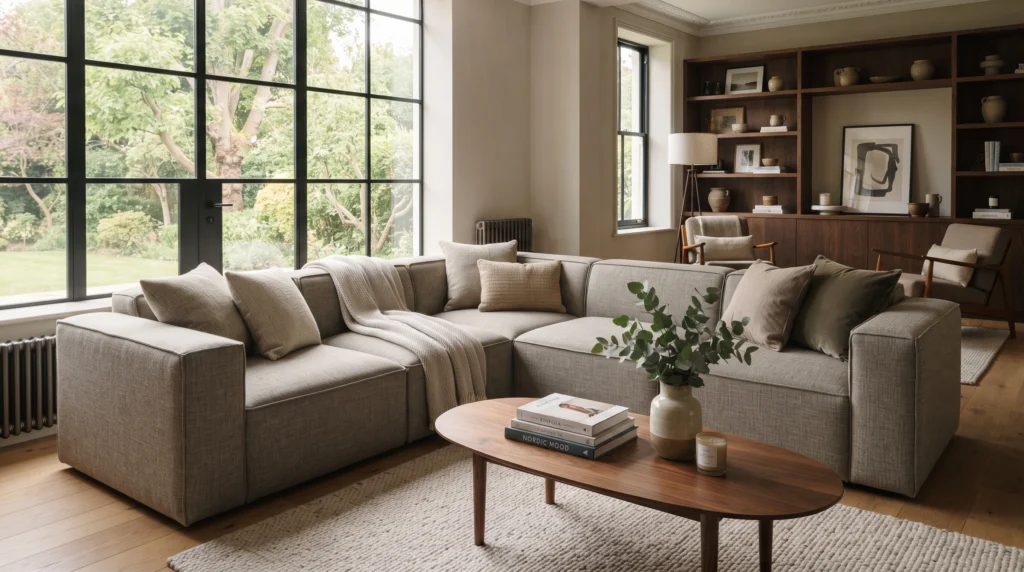
Buying a new sofa often comes with a hidden layer of stress: figuring out if it will actually fit through your front door, navigate the hallway, and suit the layout of your living room.
Modular sofas have become the go-to solution for these exact problems. By breaking a large piece of furniture down into independent, configurable units, they offer a level of flexibility that many traditional fixed sofas cannot provide.
However, buying a modular system requires a different approach to shopping. You aren’t just picking a design; you are planning a configuration, checking individual module dimensions, and evaluating connector systems.
This guide explains how to choose, measure, and configure a modular sofa that works for your specific home.
What Is a Modular Sofa?
A modular sofa is a seating system built from independent units that can be arranged in multiple ways.
You will often see the terms “modular” and “sectional” used interchangeably by UK retailers, but there is a conceptual difference worth noting:
- Sectional sofas generally refer to seating made from multiple connected sections (like a main sofa attached to a chaise). These are often sold as a specific configuration with less flexibility than a fully modular system.
- Modular sofas emphasise configuration flexibility. The individual seating modules are designed to be rearranged, split up, or, in some systems, expanded with additional pieces.
The Anatomy of a Modular Sofa
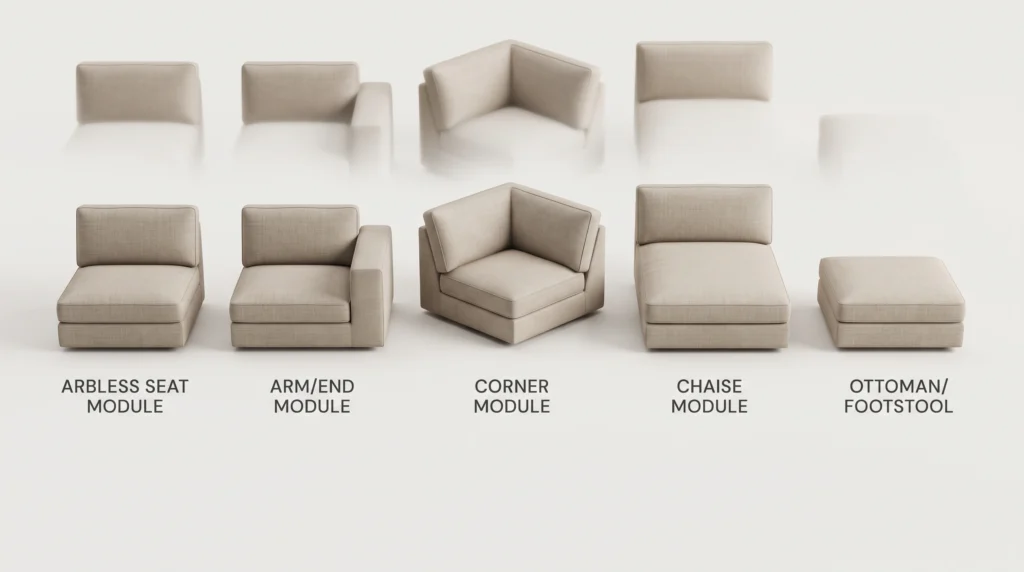
To build a configuration, you need to understand the core building blocks commonly found in modular sofa systems:
- Armless units: The standard middle seats with no armrests.
- Arm/End units: The pieces that finish the left or right side of the sofa.
- Corner units: The 90-degree pieces that allow the sofa to turn and form an L or U shape.
- Chaise units: Elongated seats designed for stretching your legs out.
- Ottomans/Footstools: Floating, backless pieces that can be used to extend the seating area, create a chaise-style arrangement, or act as a coffee table or extra seat.
The Configuration Decision Framework
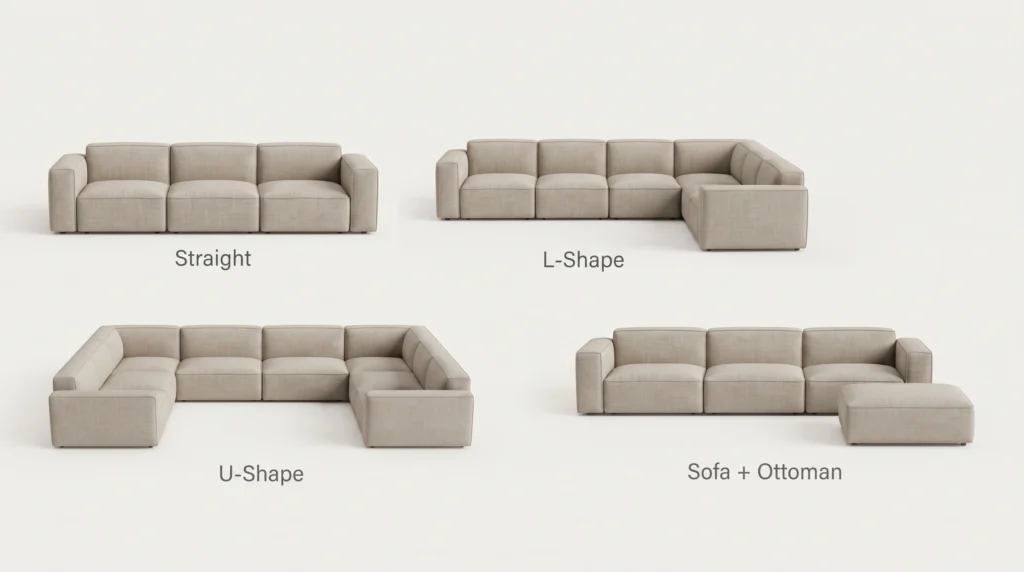
Choosing the right setup depends entirely on your room’s architecture and how you use the space. Before looking at fabrics or prices, decide on your core layout.
For small or narrow rooms: The Straight Run + Ottoman
Avoid bulky corner units that dictate the flow of the room. A straight two- or three-seater configuration paired with a floating ottoman gives you the comfort of a chaise, but the ottoman can be moved out of the way when you need floor space.
For open-plan living: The L-Shape
An L-shaped configuration is an excellent zoning tool. Placing the back of the sofa towards a dining or kitchen area creates a clear visual boundary between the cooking and relaxing zones without needing a physical wall.
For frequent movers: Independent Modules
If you rent or plan to move, prioritise smaller, standard-sized modules over highly unusual curved pieces. An L-shape that perfectly fits a left-hand corner in your current house can easily be reconfigured into a straight sofa and a separate standalone chair in your next property.
For media rooms and families: The U-Shape
If you are building a dedicated media set-up for watching TV or gaming, a well-planned U-shape can give multiple people a good viewing position. Look for modules with deep seats, wide armrests, and highly durable upholstery.
A Crucial Caveat: Left-Hand vs Right-Hand Configurations
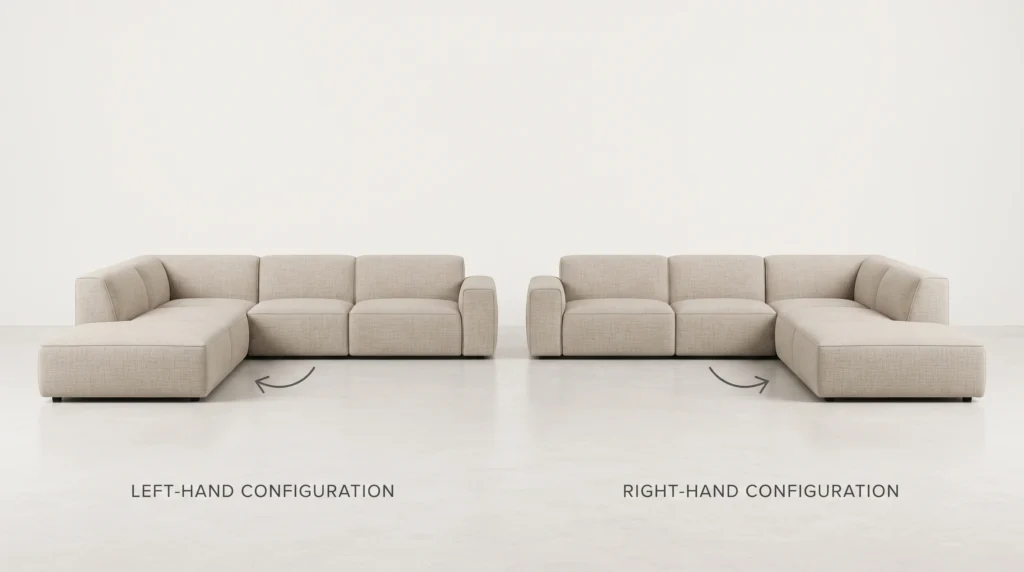
When planning an L-shape or adding a chaise, always check the manufacturer’s definition of a “left-hand” or “right-hand” configuration. Some brands describe the orientation as you look at the sofa from the front; others describe it from the perspective of sitting on the sofa. Verifying this detail prevents costly ordering mistakes.
How to Measure Your Room (The Right Way)
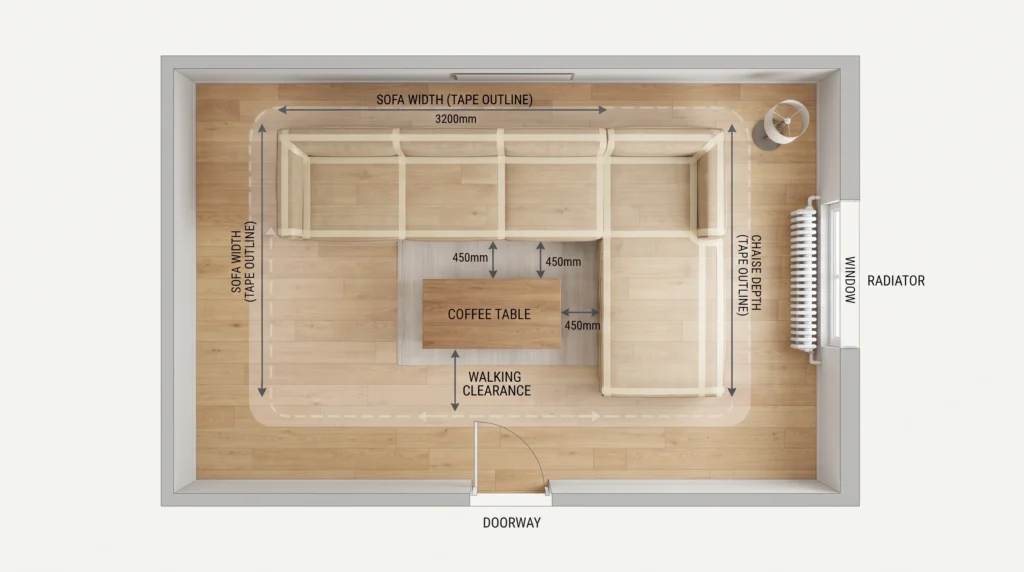
A common mistake is only measuring the total width of the final sofa. A 300cm footprint doesn’t tell you if the sofa actually works in the room.
Before ordering, map out the exact dimensions of your proposed configuration on the floor using masking tape or flattened cardboard. This same approach to planning furniture around available floor space is useful when arranging other functional areas of the home.
Check the clearances:
- Walkways: Does the chaise projection leave enough room to walk past comfortably?
- Coffee tables: Leave enough clearance for comfortable legroom and a usable walking route; around 45–50cm is a common starting point, but your specific room layout and table depth should determine the final distance.
- Obstructions: Will the back of the sofa block a radiator? Does a door swing inward and overlap the sofa’s footprint? Check the height of the sofa back against your windowsills.
Will It Fit? The Delivery Route Checklist
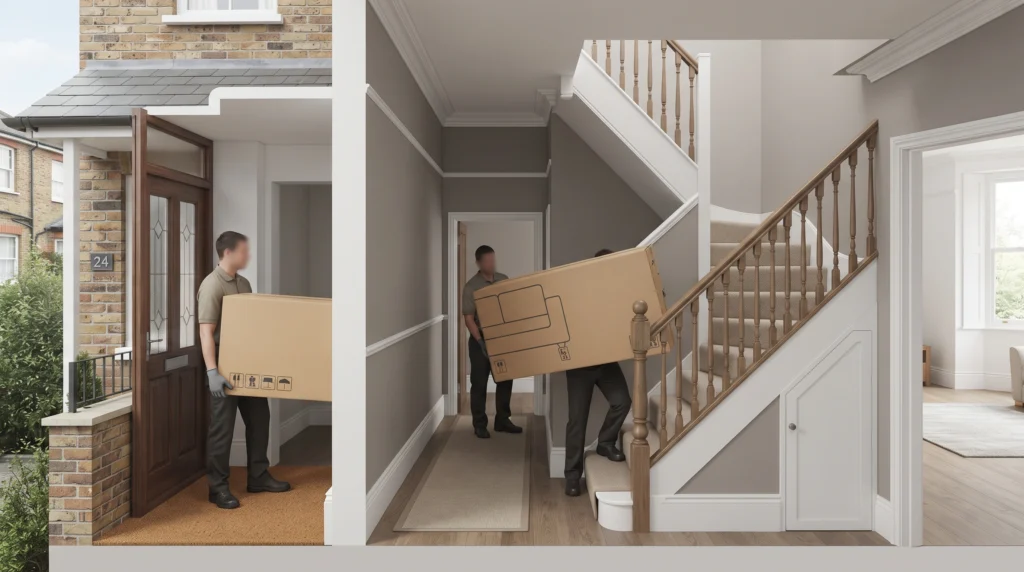
Modular construction can make delivery easier because the sofa is divided into smaller pieces, but every module and its packaging still needs to be checked against your access route.
Do not assume that “modular” guarantees easy access. Corner modules, deep-seat units, and fixed armrests can still be surprisingly bulky.
The tightest point in your delivery route can become the limiting measurement. Check the packaged dimensions of the largest single module against:
- The clear opening of your doors: Don’t just measure door leaf width; measure the actual clear passage when the door is open, accounting for the frame and handles.
- Hallway width and tightest turns: Can the delivery team physically turn the box through the tightest part of the hallway?
- Stairs and landings: Measure the stair width, the lowest ceiling point, and the depth of the landing.
- Lifts: If you live in a flat, check both the lift door opening and the interior cabin dimensions.
How Do the Modules Stay Together?
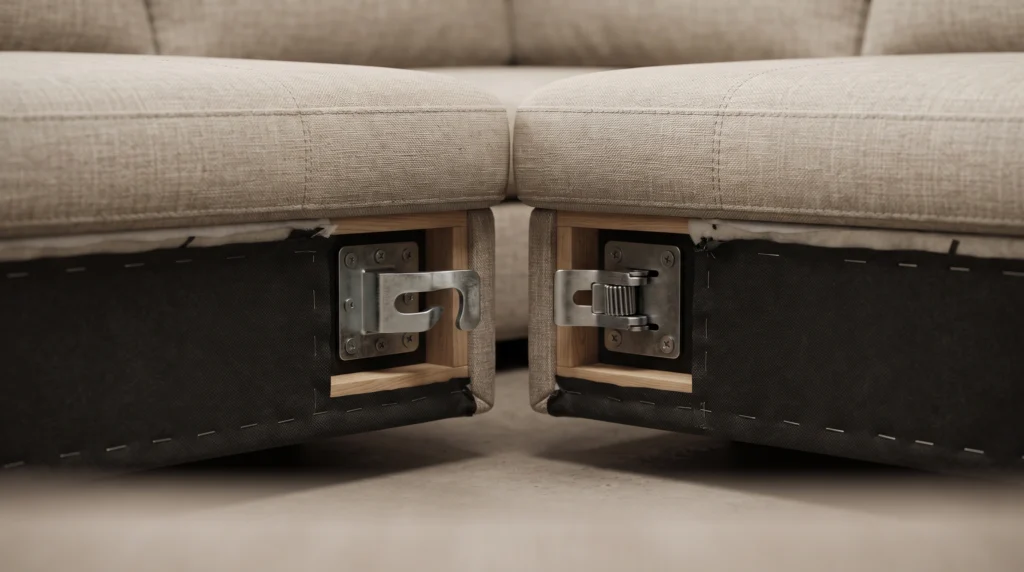
A well-designed modular sofa should keep its sections securely connected during normal use. However, connector systems are manufacturer-specific.
Common mechanisms include heavy-duty crocodile clips hidden underneath, U-brackets that drop into place, or high-friction rubberised feet for heavier units on hard floors.
When evaluating a sofa, ask the retailer:
- Are the connectors visible when the modules are separated?
- Do I need tools to change the layout?
- Do I have to physically lift heavy modules to separate them for cleaning?
- Will this specific connector system prevent the sofa from sliding on my wooden/laminate flooring?
- Are replacement connectors available if one breaks?
Expanding Your Sofa Later: What You Need to Know
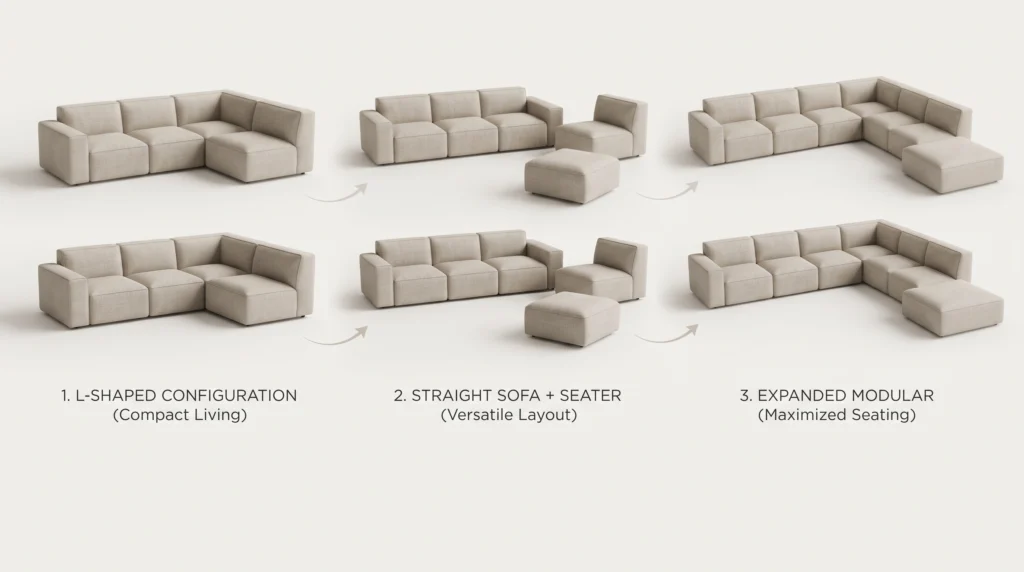
The ability to add another seat later is a major selling point, but it requires careful planning. Never assume a retailer will stock your exact sofa range forever.
If you plan to expand your sofa in the future, save these details at the time of your original purchase:
- The exact model and range name.
- The specific names and dimensions of the modules you bought.
- The fabric name and manufacturer colour code.
- Your purchase date.
Keep in mind that fabrics fade over time, and manufacturers frequently change dye lots. A new grey module bought three years later may not perfectly match your original grey sofa.
What Affects the Cost of a Modular Sofa?
Pricing a customisable sofa is different from buying a fixed unit. Retailers often advertise a low “starting from” price, which usually only covers a basic two-seater configuration in the entry-level fabric tier.
The final price depends heavily on your configuration and the options you select. Corner units are structurally complex and can be among the more expensive pieces in a modular system. Adding a chaise, upgrading to a premium upholstery option (such as velvet or leather), or adding recliner mechanisms will significantly increase the final cost.
Always price up your complete, exact configuration before committing to a specific range.
The Drawbacks: Is a Modular Sofa Right for You?
While flexible, modular systems aren’t for everyone.
- Visible seams: Because the sofa is made from separate modules, joins between sections may be more visible than on a conventional fixed sofa.
- Potential movement: Even with good connectors, individual modules can sometimes shift slightly during heavy use, requiring occasional readjustment.
- Higher costs: A comparable modular configuration can also cost more than a fixed sofa, particularly when you add corner units, chaise sections, premium upholstery, or mechanisms such as recliners.
A Note on Earlier Modular Systems
(For context on how modular seating has evolved, this page originally explored the Doimo Salotti ‘Under’ system—a modular seating system that illustrated the flexibility of customisable furniture. While specific legacy models like the ‘Under’ may no longer be widely available, the core concept of fully adaptable living room furniture has now become an established option in the UK furniture market.)
UK Buying Checklist & Safety Regulations
Before finalising your purchase in the UK, verify the following:
- Fire-safety compliance: UK upholstered furniture is subject to specific fire-safety requirements under the Furniture and Furnishings (Fire) (Safety) Regulations. These rules were amended in October 2025, including changes to display-label requirements, while permanent labelling requirements remain. Check that the sofa complies with the current regulations and that the required permanent label is securely attached.
- Returns policies: If you miscalculate the size, will the retailer accept a return? Many retailers classify specific modular configurations as “custom-made” or “made-to-order,” which can affect your standard return rights.
- Delivery and assembly: Check if the delivery fee includes carrying the modules into your room of choice, unpacking them, and connecting the system together, or if it is simply a doorstep drop-off.
The right modular sofa is less about choosing the biggest configuration and more about choosing one that works with your space, access route and the way you actually use your home. Measure before you order, confirm how the modules connect, and price the complete configuration rather than relying on a starting price.
If those checks all work, a modular sofa can give you the flexibility to change your living room without replacing the entire sofa.