
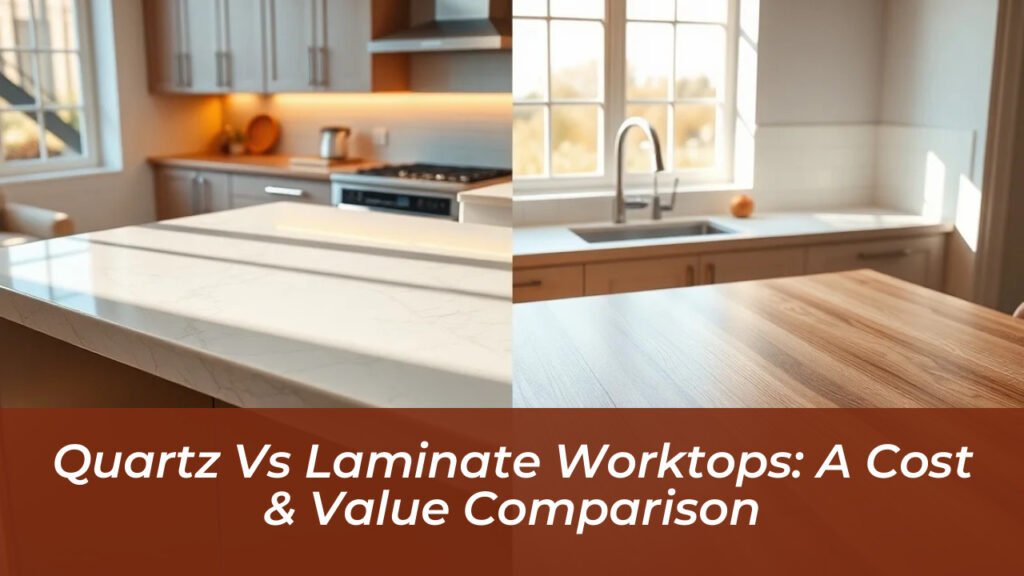
Choosing new kitchen worktops is one of the most significant investments you will make during a renovation. When comparing quartz and laminate, you are looking at two very different ends of the pricing and performance spectrum. Understanding the actual cost difference-beyond just the price per square foot-helps you balance your upfront budget with your long-term expectations.
The Upfront Price Gap: What Do They Actually Cost?
Price is almost always the deciding factor when homeowners weigh quartz against laminate. The gap between the two materials is substantial, but modern manufacturing has changed what you get for your money.
Standard laminate worktops typically cost between $20 and $50 per square foot installed. For an average kitchen layout requiring roughly 40 square feet of surface area, your total material and installation costs will generally land between $800 and $2,000. Premium high-definition laminates push slightly higher into the $35 to $50 per square foot range, but they remain firmly in the budget-friendly category.
Quartz worktops sit in an entirely different financial bracket. Installed quartz usually ranges from $50 to $150 per square foot, depending on the slab brand, thickness, and complexity of the edge profile. For that same 40-square-foot kitchen, a quartz installation runs anywhere from $2,000 to $6,000-or significantly more for rare designer slabs and complex custom islands. This means quartz frequently costs two to four times more than laminate.
Hidden Costs and Installation Expenses
The sticker price on a sample board rarely tells the whole story. When you look at total project costs, installation requirements introduce further differences between the two materials.
Quartz Installation Factors
- Professional Fabrication: Quartz slabs are extremely heavy-often weighing 20 to 25 pounds per square foot for standard 3cm thickness-and require specialist diamond-cutting equipment. You cannot install quartz yourself.
- Edge Profiles and Cutouts: Elaborate edge shaping, sink cutouts, and hob cutouts add to the fabrication labor fee.
- Templating Fees: Professional templating ensures the stone fits your walls precisely, which is standard practice and often built into the overall quote.
Laminate Installation Factors
- DIY Potential: Pre-cut laminate lengths are widely available at home improvement centers, making them a viable weekend project for skilled DIYers who want to bypass labor charges entirely.
- Custom Fabrication: If you order custom-shaped laminate runs, professional installation fees will apply, though they are generally lower than stone fabrication costs.
- Accessories: End caps, edging strips, and specialized joint adhesives add minor expenses to a laminate project.
Durability and Lifespan: Measuring Long-Term Value
A lower upfront cost only represents good value if the material holds up to daily use. Here is how quartz and laminate compare when subjected to real-world kitchen conditions.
Quartz is an engineered stone composed of roughly 90 to 93 percent crushed quartz bound with high-strength polymer resins. This composition creates a non-porous surface that resists scratching, staining, and moisture. It handles everyday spills, heavy pots, and kitchen hustle with ease. A well-maintained quartz worktop easily lasts 25 to 30 years or more.
Laminate relies on a thin decorative paper layer fused to a particleboard or MDF substrate. While modern high-resolution printing makes contemporary laminate look surprisingly convincing-often mimicking high-end marble or concrete-the underlying material is fundamentally more vulnerable.
Moisture is the primary enemy of laminate. If water breaches the seams, edges, or sink cutouts, the particleboard substrate can swell, causing the surface to bubble and lift. , laminate scratches much more easily than quartz, and heat from a stray hot pan can permanently scorch or melt the decorative resin layer. Consequently, standard laminate worktops typically have a lifespan of 10 to 20 years before showing significant wear.
Resale Value and Return on Investment
If you plan to sell your home within the next five to ten years, your choice of worktop impacts buyer perception.
Quartz is widely recognized as a premium feature in real estate listings. Homebuyers view quartz as a durable, luxury upgrade that requires minimal future investment. Installing quartz can help a kitchen feel modern and well-appointed, often recovering a substantial portion of its installation cost at resale.
Laminate, conversely, is generally viewed as a functional budget choice. While buyers accept laminate in starter homes, rental properties, or utility rooms, it rarely adds perceived value to a primary residence kitchen during a major sale.
Making Your Decision: Which Worktop Fits Your Project?
Choosing between quartz and laminate ultimately comes down to your project context, timeline, and budget parameters.
Choose quartz if: You are renovating your forever home, you cook heavily every day, you want the authentic look and feel of natural stone without the maintenance, and your budget allows for a long-term investment that adds measurable property value.
Choose laminate if: You are flipping a property, outfitting a rental unit, working with a strict renovation budget under $2,000, or planning a future gut-remodel where temporary performance is all you need. Modern laminate delivers fantastic visual appeal at a fraction of the cost, provided you are willing to use cutting boards and trivets diligently.